
From personal convenience to business operations and scientific discoveries, AI is rapidly transforming industries worldwide – and recruitment is no exception. But for employers and job seekers alike, one element of this revolution is becoming worryingly common and increasingly hard to ignore: the use of AI-generated content. In this post, we’re going to discuss its use in recruitment advertising, the risk of leaning too heavily on algorithms, and, ultimately, why it’s essential to strike a balance between automation and the human touch.
AI in Recruitment: Hiring Made Smarter
With nearly half of UK organisations now actively experimenting with or implementing generative AI tools in their hiring processes, it’s fair to say that artificial intelligence is making its mark on the recruitment industry. The reason behind its popularity is clear: from automating onboarding operations to scanning CVs and scheduling interviews at the click of a button, incorporating AI into your recruitment strategy is a surefire way of streamlining time-consuming and demanding tasks.
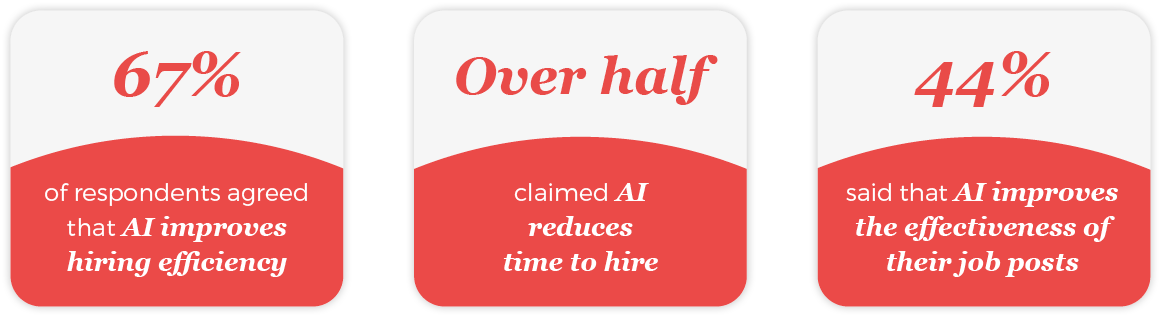
Talent acquisition professionals across the UK are singing its praises. According to the United Kingdom Future of Recruiting Report 2025:
Even the placement and targeting of adverts on social media is influenced by AI. For example, Meta’s AI uses ad frequency and relevance to determine the price and display rate of adverts on Facebook and Instagram. This type of use is invaluable since human beings simply don’t have the capacity to analyse data at this level or manage thousands of targeting variables.
Recruiters Aren’t All On Board
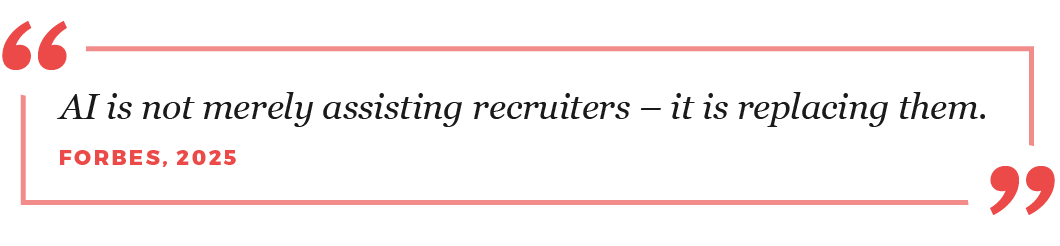
It’s interesting to note that while AI certainly has its benefits when it comes to streamlining hiring processes, many recruiters remain wary, particularly in the not-for-profit sector. A staggering 77% of respondents to a 2024 CharityJob survey agreed that AI could have negative consequences for recruitment, and nearly half asserted they wouldn’t trust recommendations made by AI, suggesting a reluctance to fully surrender human judgement in recruitment decisions.
Alongside concerns that AI will replace human influence in recruitment lies another element worth examining: AI-generated content. From job descriptions to company slogans to candidate cover letters, content created by machines is on the rise. But rather than helping people stand out, its ubiquity undermines authenticity – both for the recruiter and the job seeker. Let’s take a closer look.
AI-Generated Content in Advertising
AI-generated content is pervasive on the platforms we use every day – a recent analysis, for example, estimates that over half of longer English-language posts on LinkedIn are written by AI. Indeed, once you start picking up on the telltale signs, you’ll start noticing it everywhere. Common giveaways include the overuse of buzzwords like “elevate” and “leverage”, US English spelling conventions (think synchronize instead of synchronise), and em dashes—like this—in abundance.
Falling Short: AI Slop and A Lack of Character
So prevalent is AI-generated content, in fact, that a new term has started making the rounds online: ‘AI slop’. Defined in one Entrepreneur article as “the filler content produced by AI tools that prioritise speed and quantity over substance and quality”, AI slop is beginning to receive backlash that has led to substantial shifts in creative industries. For instance, according to the Freelancer Fast 50 Global Jobs Index, freelance recruitment platforms are witnessing a sharp increase in adverts for writers, designers and video editors, suggesting that “businesses are drawing clearer lines between automated output and the type of nuanced, human creativity that machines still fail to replicate convincingly.” Freelancers and influencers are being hired in droves to produce emotionally resonant and delicately layered language that AI tools simply cannot deliver, with output increasingly expected to pass a test of authenticity – not artificiality.
When it comes to recruitment, using AI-generated language in your adverts and hiring practices also runs the risk of isolating candidates. We know that personalisation is vital when it comes to communicating with job applicants. According to Glassdoor, 72% of job seekers expect some level of personalisation when communicating with a company during the hiring process, while a Deloitte report suggests that companies that personalise the hiring process can boost candidate engagement by 50%. What’s ironic is that while AI tools promise personalisation at scale by analysing candidate behaviours, preferences and engagement patterns, once you become familiar with AI-generated content, the messages feel far less personal. Correspondence has become data-driven, no longer based on human understanding or a genuine desire to get to know another person.
AI in Job Applications
Just as a candidate seeks a personalised hiring and onboarding experience, recruiters want to get to know who they’ll be working with on a real, human level. With the rise in AI tools, writing a cover letter or formatting a CV can be achieved instantly – but what may seem efficient in theory may be harming job seekers in practice. In fact, a CV Genius report showed that:
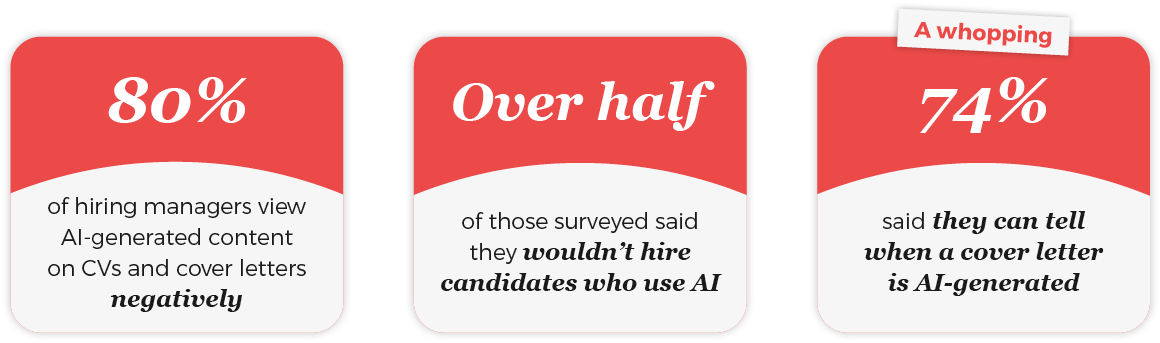
The fact is, as clever as these tools are, AI-generated language – that ‘AI slop’ – is obvious, and it’s hard to conceal. When James Robinson of Hello Starling, a Cardiff-based ad agency, took to LinkedIn to share a concerning rise in the number of AI-generated job applications, he quickly learned he wasn’t alone, with many other users describing cover letters as being riddled with vague and transparently AI-written sentences such as “my skills align with your organisation’s objectives”. Robinson highlighted the additional risk of hiring candidates who aren’t “capable of doing the job” but are, instead, proficient enough in AI technology that they could construct a version of themselves that meets all the criteria.
The wave of AI-generated CVs and cover letters has also made it harder for candidates to stand out, leaving many reluctant to apply. As recruitment consultancy Adria Solutions notes, AI “adds complexity for applicants”, with many feeling “pressure to focus on keywords rather than telling a clear, authentic story about their experience”. A CharityJob survey questioning candidates about their use of AI in job applications found a similar result. According to the report, 60% of respondents felt that it is now harder to stand out in a job application due to other candidates’ increased use of AI to tailor their applications. Not only is AI-generated content harming candidates’ opinions of recruiters, then: top talent is being stymied by a buzzword-drenched market.
Using AI Writing Tools Effectively
With all that said, there’s no doubt that AI writing and editing tools have their place. Whether it’s using the built-in spellcheck on Microsoft Word, feeding an essay into Grammarly to check for consistency, or asking ChatGPT to help you phrase a particularly tricky email, AI assistance is invaluable in a modern world.
There’s also an argument for the effective incorporation of AI tools into your content creation strategy. In the initial phases of a creative project, having a brainstorming partner – or just a place to ‘brain dump’ – is incredibly useful, and when you know roughly what you want to say but struggle with how to say it, AI is an obvious starting point. From rapidly generating topic ideas or argument frameworks to producing workable first drafts that can later be refined, AI – when used appropriately – can help make the transition from a blank page to a watertight piece of work far less arduous.
In one Medium article, writer Daniel Silva spoke about harnessing AI’s capabilities to help him finish a novel he had been working on for years. What’s notable here is that rather than using AI as a replacement, Silva utilised it as a means of creating a roadmap, describing it as a “powerful solution to the age-old challenge of writer’s block”.

Striking the Balance
Indeed, AI writing tools are fantastic for sparking ideas and generating starting points, as long as you view them as just that: tools. As with anything, it’s all about finding a balance, as many creative organisations are beginning to realise: a recent TechRadar report suggests a trend towards a more hybrid approach, “leaning on machines for efficiency while entrusting humans with the final creative direction”. Saul Poses, Head of Customer Marketing at Dixons Carphone, echoed this method: “Combining creative people with AI is the next step for the agencies.”
It need not be AI versus the human: rather, algorithmic predictability must be balanced with personal style and with the power of the human touch. As veteran copywriter and advertising executive Rory Sutherland noted, advertising “is about producing something distinctive. It’s not a production line”. As we’ve seen, AI often falls short when it’s used as a replacement and not an assistant. After all, AI writing tools are only as good as the data they are fed, and they can only go so far, meaning that, especially when it comes to recruitment, it’s becoming increasingly harder to stand out in an already competitive and now slop-drenched market.
What’s the Verdict?
While AI has a role to play in recruitment and marketing more widely, it’s vital to remember that these powerful tools work best when guided by human judgement. Efficiency is important, but it’s authenticity that truly sets you apart, whether you’re hiring or applying. And with audiences growing weary of generic AI-generated content, there’s never been a better time to lean into what makes us truly different: original, human creativity.
At Point 13, we believe that what gives you the edge isn’t jumping on yet another bandwagon – it’s meaningful communication that resonates, whether you’re attracting your ideal employee or getting your audience excited about something new.
As proud champions of the human touch, we can help you mop up the ‘AI slop’ and transform your recruitment advertising and marketing campaigns into something that connects – all while staying true to what makes you you. Ready to get creative? Get in touch and discover how we can help.